Riesling tasting sheet
Make the sheets View: A4 · Letter
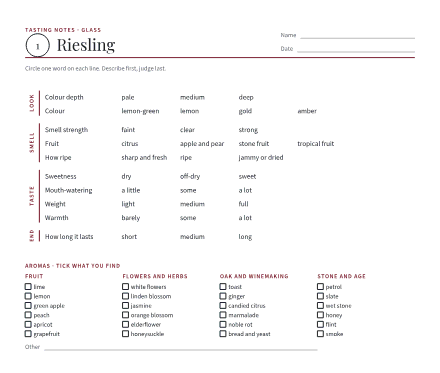
Riesling takes the top of this notes page, and the rows below are the white wine set, from colour depth and colour to the fruit, how ripe it is, sweetness, mouth-watering, weight, warmth and how long it lasts. The sweetness line matters more here than for any other grape, since Riesling runs from dry through off-dry to sweet, while the mouth-watering line is nearly always filled at the top. Weight is usually light and warmth low, especially in Germany. The aroma list is tuned to the grape: lemon and lime, green apple, peach and apricot in the fruit, orange blossom, jasmine and linden blossom among the flowers, marmalade and candied citrus for the late-picked styles, and in the last family slate, wet stone, honey and petrol, the aroma every Riesling taster learns. The conclusion asks for country, region and age, which with Riesling are often the hardest part. One page per wine.
Serve it cool, about 8 to 10 °C, and pour a small taste. Circle the sweetness line before the rest of the taste, since high acidity can make an off-dry wine feel dry, and the page asks you to separate the two. An older bottle is the easiest way to find petrol and honey, a young one shows lime and apple. A good evening on your own is a dry Clare Valley or Alsace bottle next to a German Kabinett, a page each, so the sweetness and the weight lines tell them apart. Print one page per wine and the how-to page for the scales. Riesling's low alcohol makes it easy to taste several, though it is still worth spitting and keeping water between glasses.
Questions
Is Riesling sweet or dry?
Both. Riesling is made from bone dry to lusciously sweet, and labels do not always say which. Trocken on a German label means dry, Kabinett and Spätlese are often off-dry, and most Australian and Alsace Riesling is dry.
Why does Riesling smell of petrol?
A compound that forms as Riesling ages, especially in sunny places, gives a note many tasters call petrol or kerosene. It is a sign of age and a famous clue in blind tastings, not a fault.
More pages like this
Wine tasting sheets by kindWine tastings by occasionWine tasting sheets by grape